What a TCM Practitioner Is Actually Doing When They Assess You
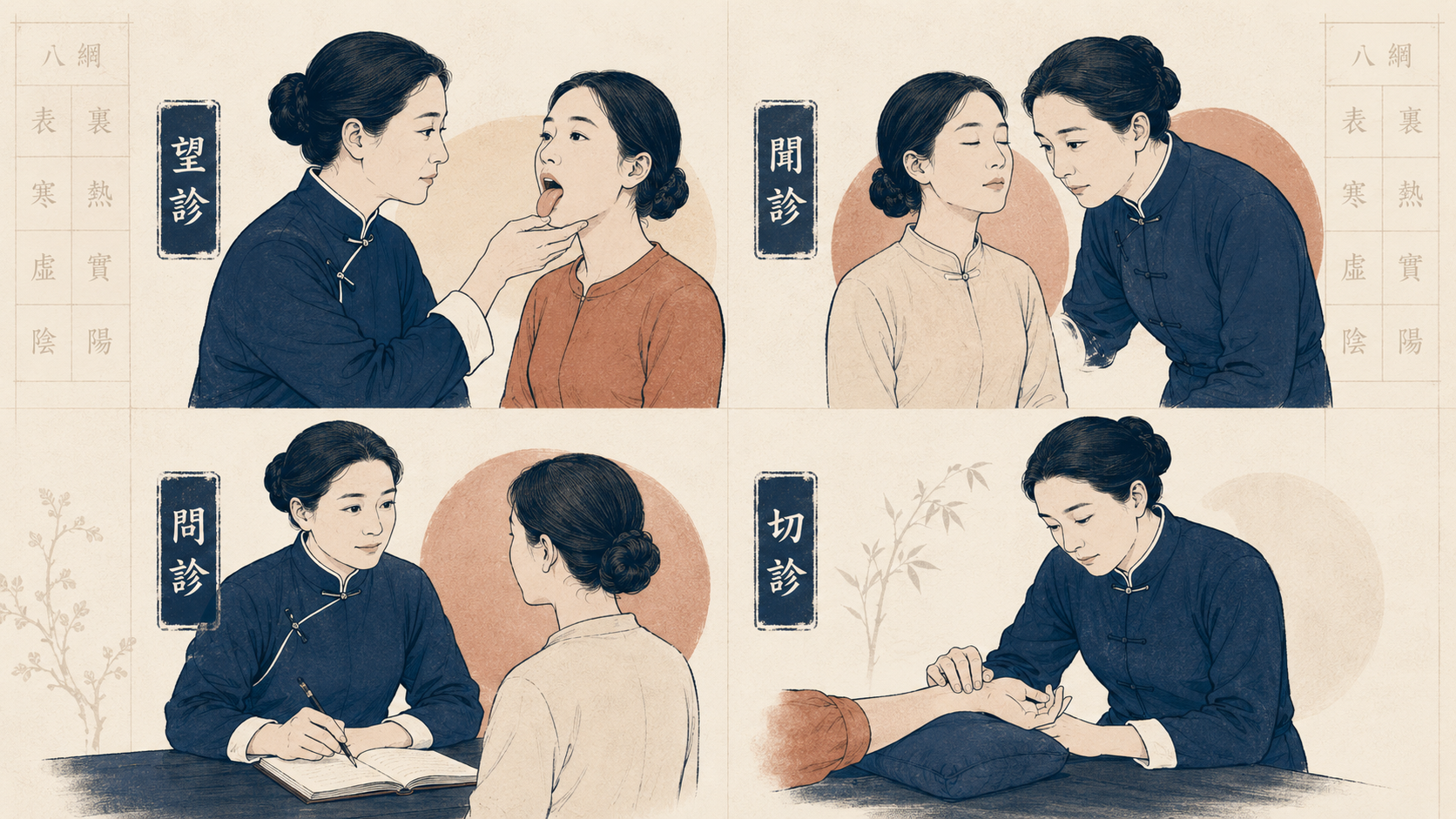
Most patients notice that a TCM consultation feels different from a GP visit. You get asked about your sleep, your digestion, whether you run hot or cold, how your mood shifts across the week. Your tongue gets looked at. There's time spent on things that seem unrelated to why you came in.
None of it is random. TCM diagnosis runs on a structured framework built around four assessment methods and eight diagnostic principles. Here's what those actually are.
The Four Diagnostic Methods (四診)
Looking (望診)
The first assessment starts before you say anything. Complexion, posture, the colour and moisture of the lips, the quality of the eyes — these give an initial read on the state of the body's internal environment. The tongue is the most structured part of this. Tongue body colour, shape, moisture, and coating each correspond to different internal systems. A pale tongue body reads differently to a red one. A thick white coating reads differently to a thin yellow one. The tongue is essentially a visible surface that reflects what's happening internally.
Listening and Smelling (聞診)
Voice quality, the strength or weakness of breathing, and the nature of a cough all carry diagnostic information. A strong, loud voice tends toward excess patterns. A weak, quiet one tends toward deficiency. This isn't always obvious to a patient, but to a practitioner listening for it, it's consistent data.
Asking (問診)
This is usually the longest part of the initial consultation. The questions cover sleep quality, appetite, digestion, thirst, temperature preference, pain location and character, bowel and urinary function, and for women, the menstrual cycle in detail. Each of these connects to specific organ systems and pathological patterns. The reason you get asked whether you prefer warmth or cold, or whether your pain is better or worse with pressure, is that those specifics shift the diagnostic picture meaningfully. A headache that's worse with pressure points somewhere different to one that improves with it.
Palpating (切診)
Physical palpation covers the pulse and, where relevant, direct palpation of areas of pain or tension. Pulse diagnosis reads the quality and character of circulation across different positions, each corresponding to a different organ system.
八綱: Eight Principles, Four Pairs
Once the four methods have been applied, the information gets organised through bā gāng (八綱), eight diagnostic principles arranged as four opposing pairs. Together they define where a pathological process is sitting and what's driving it.
The traditional 八綱 pairs are:
Interior vs Exterior Is the pathology at the surface of the body, or is it seated deeper in the organ systems? An exterior condition is often acute and recent. An interior one is usually chronic and established.
Hot vs Cold What is the nature of the pathological process? Heat patterns present with inflammation, irritability, a preference for cool, darker urine, constipation. Cold patterns present with dullness, fatigue, a preference for warmth, loose stool, pallor. These aren't always what a patient expects: someone who feels cold all the time may still have internal heat, and vice versa.
Excess vs Deficient Is there too much of something causing the problem, or not enough? Excess means a pathogenic factor is actively present and needs to be cleared. Deficiency means a resource has been depleted and needs to be rebuilt. The distinction determines whether treatment tonifies, clears, or moves.
Yin vs Yang The overarching pair that contains the others. Yin and Yang are broad categorisations: Yin patterns tend toward cold, deficiency, interior, and stillness; Yang patterns toward heat, excess, exterior, and activity. In practice, most presentations are a mix rather than a pure pole.
In my clinical approach, I add a fifth pair on top of the traditional four:
Dry vs Damp What is the fluid state of the internal environment? Damp patterns involve sluggish fluid metabolism, heaviness, and accumulation. Dry patterns involve depletion of fluids and moisture. Both affect digestion, circulation, and tissue quality in distinct ways, and both shift treatment significantly enough that I treat them as a core diagnostic axis rather than a secondary consideration.
These five pairs combine to produce a pattern. That pattern, not the Western diagnosis label, determines what gets treated and how. Two patients presenting with the same Western diagnosis can have opposite TCM patterns and require opposite treatment approaches. That's why the assessment takes the time it does.
If you want to understand your own pattern before booking, or you're ready to come in, get in touch via the contact form below.
