TCM Dietary Principles Explained
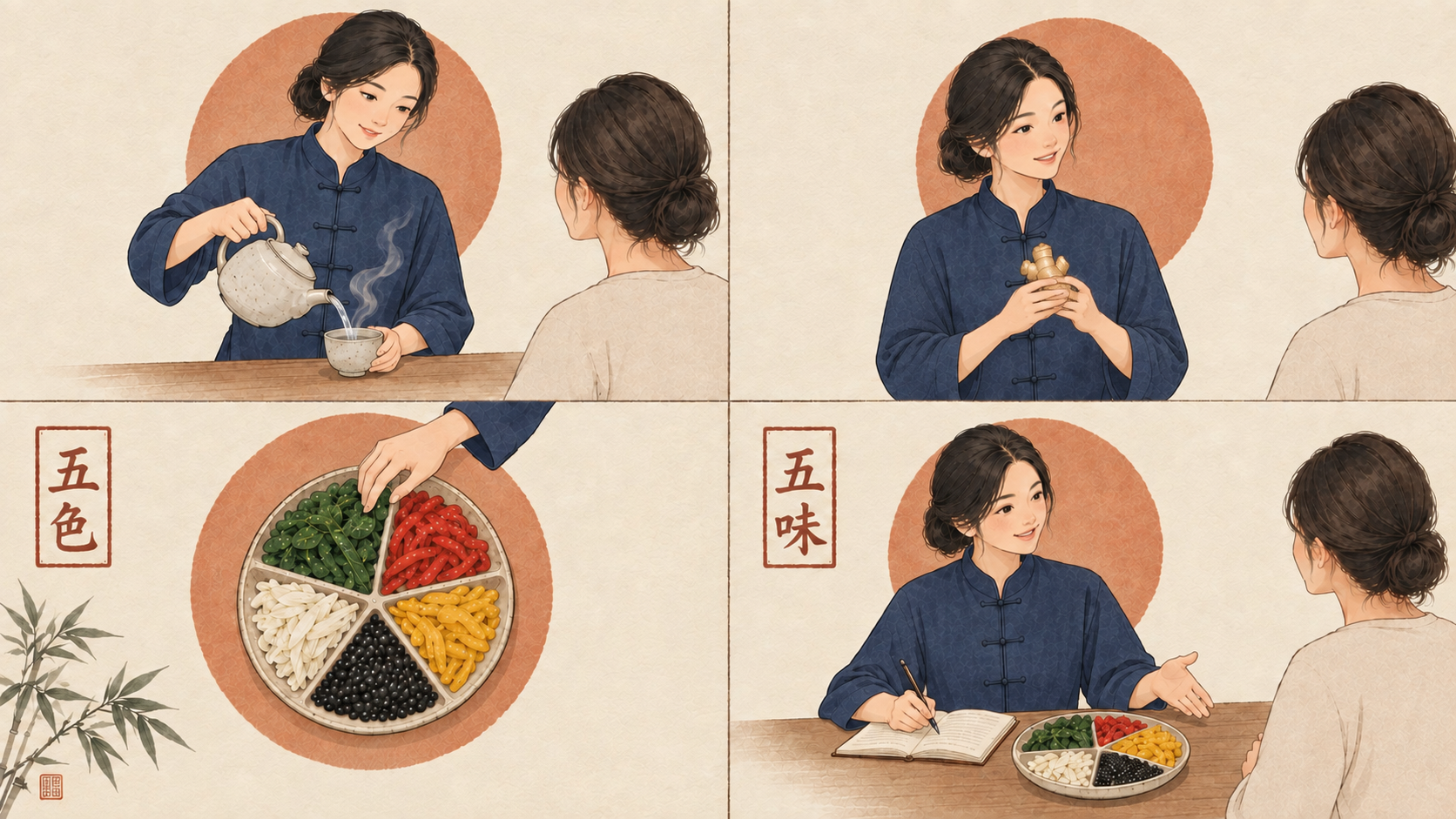
How TCM Thinks About Diet
Modern nutrition science organises food around macronutrients, micronutrients, and calories. TCM organises it around a different set of questions: what does this food do to the internal environment of the body? Does it warm or cool, dry or moisten, build or move? These aren't opposed frameworks, they're looking at different things, but the TCM approach produces dietary guidance that can look counterintuitive until the logic behind it is clear.
Three principles cover most of it.
Start with Water
Before food, water. Specifically, the temperature of it.
TCM has recommended warm water over cold for centuries, primarily because cold water hits a digestive system that operates at body temperature. The Spleen and Stomach in TCM function like a cooking pot, they need a stable internal warmth to transform and transport food into usable nutrients. Cold water doesn't just pass through; it draws on that warmth to bring itself up to temperature, adding a workload before any food has even arrived.
The research on this is narrower than TCM claims, and worth stating accurately. A study published in the European Journal of Nutrition found that water temperature affects gastric motility and satiety: cold water (2°C) reduced subsequent energy intake by up to 26% compared to warm and hot water, and the frequency of gastric contractions differed by temperature. This shows that temperature genuinely changes how the stomach behaves. In a narrower clinical context, hot water swallows have been shown to improve symptoms in patients with oesophageal motility disorders such as achalasia, though this doesn't generalise to healthy digestion. The honest position is that water temperature measurably affects gastric function, and the TCM rationale (avoiding a workload placed on the digestive system before food arrives) is a plausible mechanism, but the clinical trial literature doesn't yet establish warm water as broadly superior to cold for digestion.
The practical takeaway is specific: room temperature or warm water throughout the day. This isn't about restricting hydration, it's about not putting the digestive system in a position where it's compensating for temperature before it can do its actual job.
Food Has a Thermal Property That Isn't Physical Temperature
Every food has a thermal nature in TCM: warm, hot, neutral, cool, or cold and this has nothing to do with whether the food is served hot or cold. It's a property of the food itself, derived from its effect on the body's internal environment.
Ginger is warm. It warms the middle, moves stagnation, and disperses cold. This is true whether you eat it raw, cooked, or dried. Cucumber is cool. Watermelon is cold. Lamb is warm, cinnamon is warm.
This matters in practice because a diet can be physically warm, cooked meals, served hot but still run cold in its overall thermal character if the majority of ingredients are cold-natured. Conversely, someone who eats a lot of spicy, hot-natured foods and runs internally hot is compounding their pattern regardless of how the food is prepared.
The application is pattern-specific. Someone presenting with cold patterns: cold hands and feet, loose stool, poor appetite, needs a diet weighted toward warming foods. Someone presenting with heat: inflammation, restlessness, constipation, needs to reduce hot-natured foods even if they're eating meals at a normal temperature.
This is why TCM dietary assessment doesn't just ask what you eat. It asks how the food you eat is affecting your current internal state.
五行 (Wu Xing): Five Elements, Five Colours, Five Tastes
The third organising principle is 五行 (Wu Xing), the Five Element framework. Five elements map to five organ systems, five colours, and five tastes. Eating across all five colours ensures each organ system receives its corresponding nourishment. The Huang Di Nei Jing states it directly: white and pungent correspond to the Lungs, red and bitter to the Heart, green and sour to the Liver, yellow and sweet to the Spleen, black and salty to the Kidneys.
Modern phytonutrient research provides a useful parallel, food colour reflects the presence of specific bioactive compounds, and those compounds tend to act on the systems the TCM framework predicted.
Green (Wood, Liver and Gallbladder) Green foods support the Liver and Gallbladder. The active compounds chlorophyll and glucosinolates concentrated in leafy greens and cruciferous vegetables are associated in Western research with hepatic detoxification pathways and reduction of oxidative stress.
Red (Fire, Heart and Small Intestine) Red foods correspond to the Heart and circulation. Lycopene, concentrated in tomatoes and red vegetables, is associated with cardiovascular protection. Anthocyanins in red and dark berries. Hawthorn and goji have been studied specifically for heart benefit and associated with improved blood vessel function and reduced cardiovascular risk.
Yellow and Orange (Earth, Spleen and Stomach) Yellow and orange foods correspond to the Spleen and Stomach, the central digestive system. Beta-carotene, lutein, bioflavonoids, and vitamin C are concentrated here. These compounds support immune regulation and mucosal integrity, which in TCM terms maps to the Spleen's role in transformation, transportation, and maintaining the body's defensive capacity.
White (Metal, Lung and Large Intestine) White foods correspond to the Lung and Large Intestine. Allicin in garlic is well-researched as antimicrobial and antifungal. White foods broadly supply potassium, magnesium, fibre, and antioxidants that support respiratory and immune function.
Black (Water, Kidney and Bladder) Black foods correspond to the Kidney system. Lignans, concentrated in black sesame, have been studied specifically for organ-protective activity in the liver and kidney, alongside antioxidant and anti-inflammatory effects. In TCM terms, black foods tonify Kidney Qi, which governs reproductive function, fluid metabolism, and the body's foundational reserve of energy.
The connection between the two frameworks isn't exact, but it isn't superficial either. Both arrived at colour as a meaningful organising principle for food function, from different methodological starting points separated by two thousand years.
The practical takeaway is straightforward: eating across all five colours regularly covers the organ systems. It's not about eating one colour at a time or matching food to symptoms, it's about building a diet that doesn't systematically under-nourish any one system.
How These Three Principles Work Together
Warm water supports Spleen function. Thermal property guides what food does to your current pattern. Five colour eating ensures each organ system is covered. None of these requires abandoning what you already know about nutrition, they sit alongside it and address things that macronutrient tracking doesn't.
If your diet is consistent but your digestion, energy, or recovery aren't reflecting that, the gap is often in one of these three areas.
Get in touch via the contact form if you would like to discuss your presentation.
References
Fujihira, K., Hamada, Y., Yanaoka, T., Yamamoto, R., Suzuki, K., & Miyashita, M. (2019). The effects of water temperature on gastric motility and energy intake in healthy young men. European Journal of Nutrition, 58(4), 1523–1529. https://doi.org/10.1007/s00394-018-1888-6
Huang Di Nei Jing Su Wen [The Yellow Emperor's Classic of Internal Medicine]. (ca. 200 BCE). Chapter 10: The generation and completion of the five depots.
Institute for Functional Medicine. (2023). Phytonutrient spectrum comprehensive guide (Version 6). https://chcofcapecod.org/wp-content/uploads/2023/10/PhytonutrientSpectrum-ComprehensiveGuide1.pdf
Park, M. I. (2012). Hot water swallows may improve symptoms in patients with achalasia. Journal of Neurogastroenterology and Motility, 18(4), 355–356. https://doi.org/10.5056/jnm.2012.18.4.355
